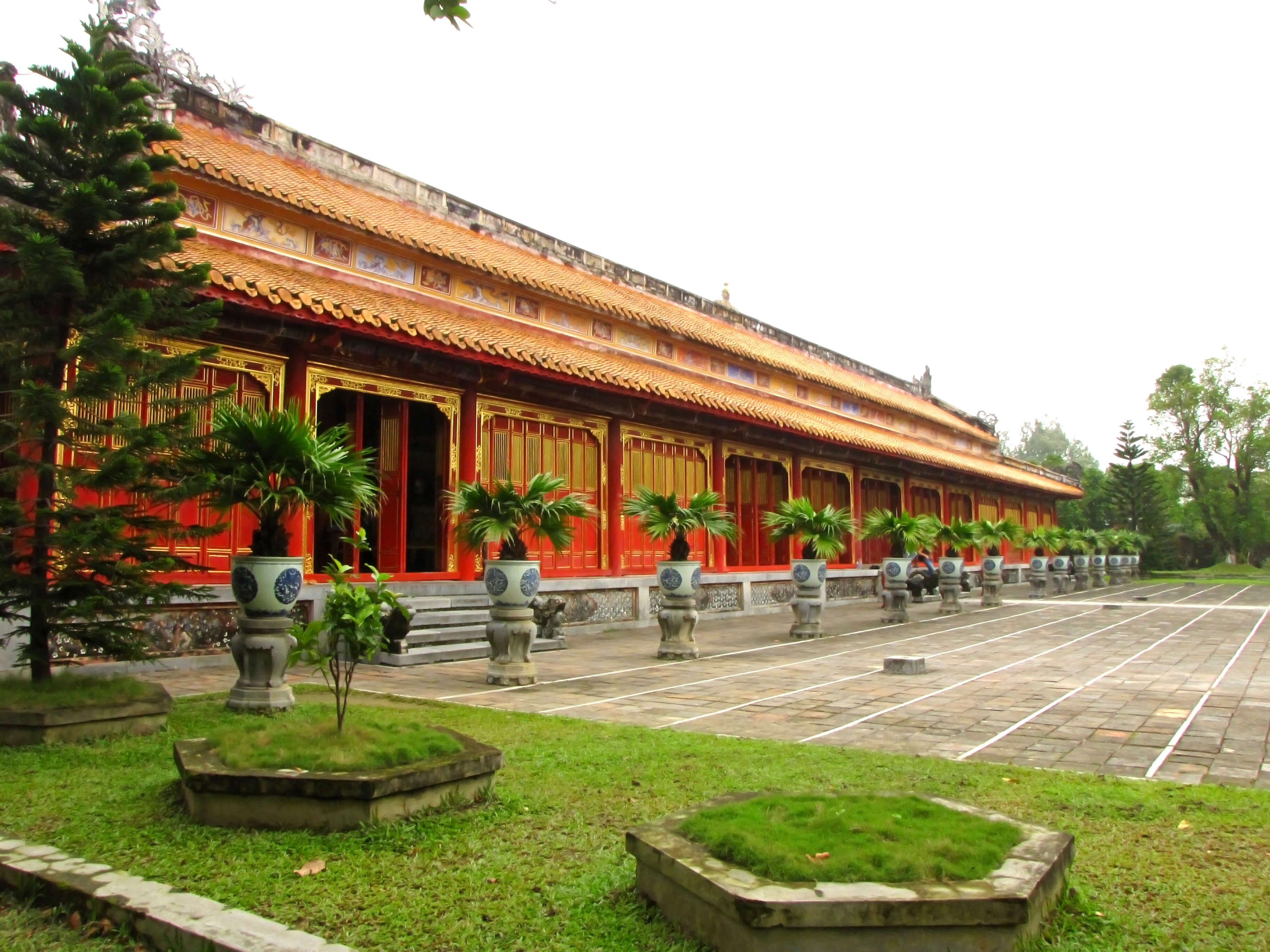
Location: The Mieu Temple is situated southwest of the Hue Citadel and facing south.
Characteristics: It's dedicated to ten Emperors of the Nguyen Dynasty, built by Emperor Minh Mang in 1821, it presents a 9 - compartment main building and a 11 - compartment front building, together connected in the "double" architecture with two bays on east and west sides.
The Mieu is roofed with yellow enameled tiles and on the ridge rests a wine gourd decorated with Phap Lam enamel. It once had seven red and yellow lacquered altars (one in the middle, three on either side).
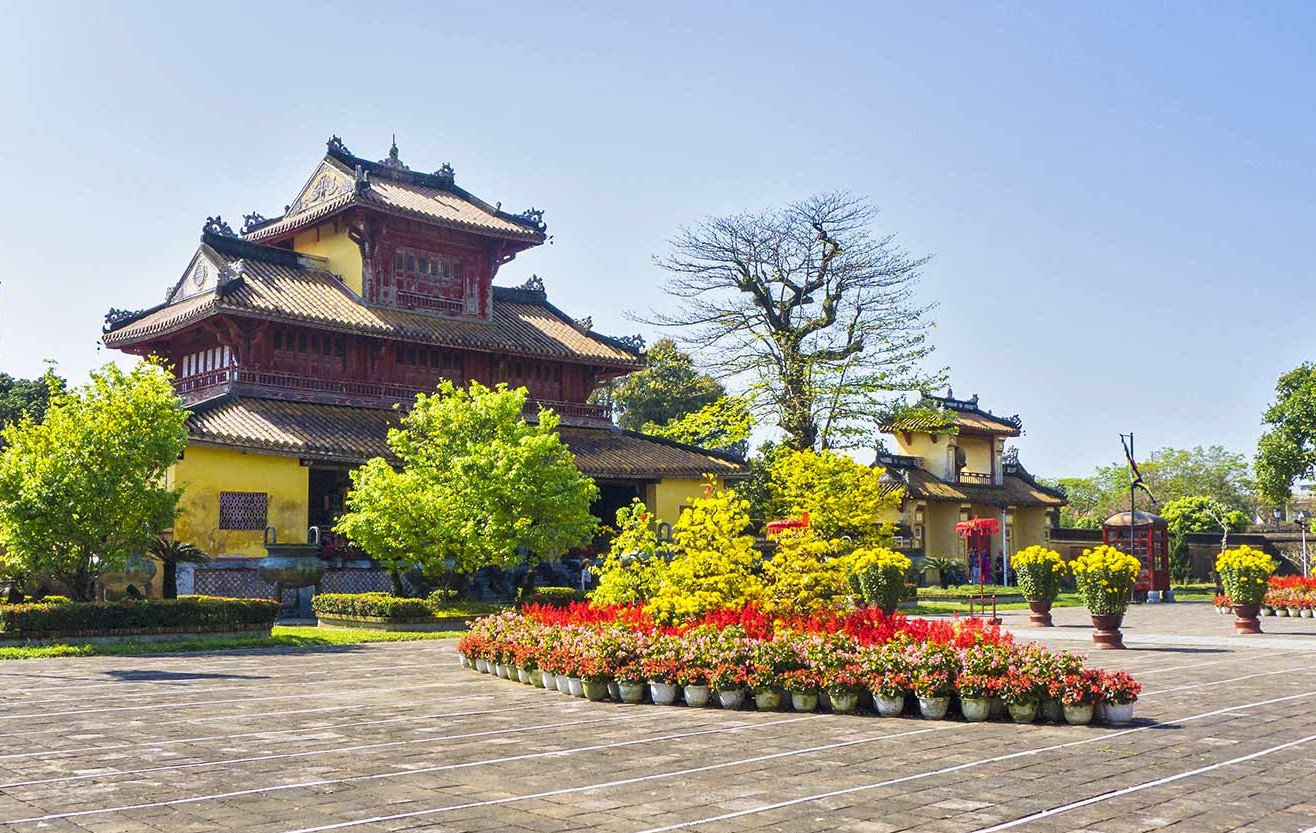
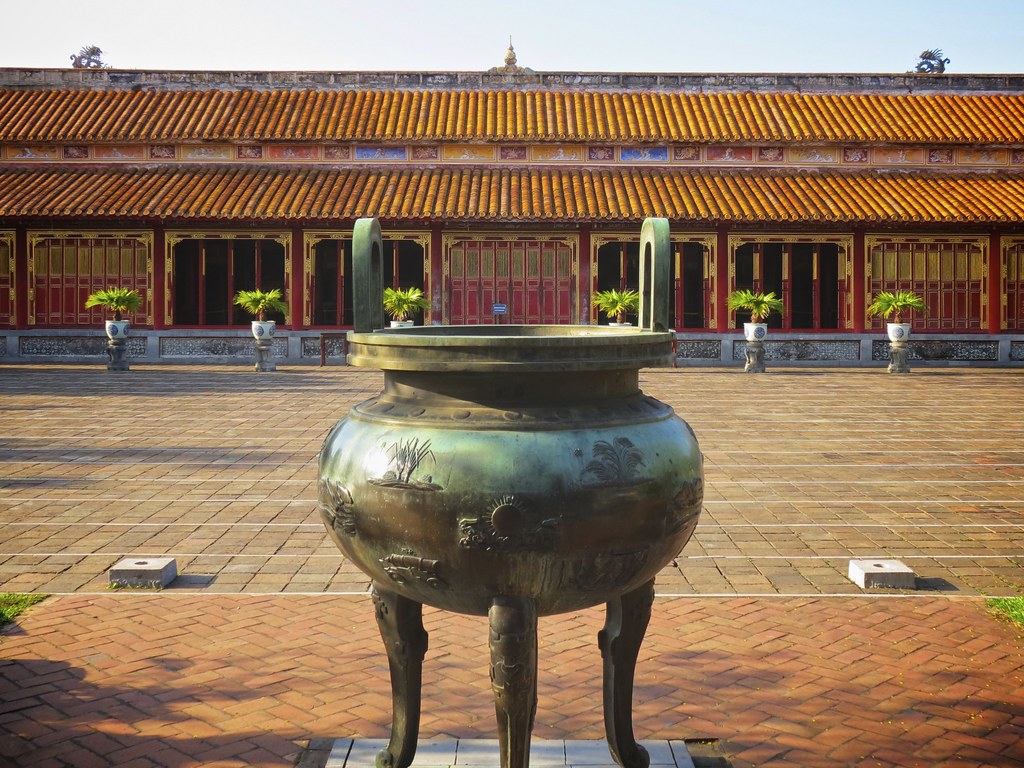
East of The Mieu is the Canh Y Palace. West of it is a square-shaped chapel for the worship of the God of Earth. A wall runs all around The Mieu with the Khai Dich Gate (Gate of Bringing Up) on the east, the Sung Thanh Gate (Gate of Peace Honoring) on the west, the Hien Huu Gate (Gate of Recognizable Assistance) (left) and Doc Huu Gate (Gate of Genuine Assistance) (right) at the back. In the yard of The Mieu stand the Nine Dynasty Urns. Behind them is a wall with the Hien Lam Pavilion (Pavilion of Glorious Coming) in the middle. Left of this pavilion is the Tuan Liet Gate (Gate of Grandness) topped by a belfry and right of it is the Sung Cong Gate (Gate of Honorable Achievements) with a drum-tower atop (The temple is architecturally similar to Thai Temple).
Outside of the Hien Lam Pavilion are the Left and Right Houses, dedicated to meritorious mandarins who had devoted themselves to Nguyen Anh (later known as Emperor Gia Long) and his successors. The Left House honors the four royal family members Ton That Man, Ton That Dien, Ton That Huy and Ton That Hoi. The Right House is dedicated to Vo Van Tanh, Ngo Tung Chau, Chau Van Tien, Vo Di Nguy, Nguyen Van Truong, Pham Van Nhon, Nguyen Huynh Duc, Tong Phuc Dam, Nguyen Van Man, Do Van Huu, Nguyen Van Nhon, Mai Duc Nghi and Truong Dang Que, accepted by Emperor Minh Mang in 1827.
On January 25th, 1959, at the request of the royal family and the people, a ceremony was held to admit to The Mieu mortuary tablets of Ham Nghi, Thanh Thai and Duy Tan, three anti - French Emperors. So today there are three additional reddish-lacquered altars for them in The Mieu.
Many personal paraphernalia of great value which belonged to the Nguyen Emperors are kept in The Mieu. On each altar were once dozens of gold ingots. Fortunately, The Mieu has suffered the least damage through the numerous wars and today visitors can see it as it was originally built.
 Latest News
01/05/2026
When travelers think of Vietnam, names like Hanoi, Halong Bay, Hoi An, or Ho Chi Minh City often come to mind. These iconic destinations are popular for good reason. However, beyond the well-trodden routes lies another Vietnam — quieter, more authentic, and deeply connected to nature and local culture. For travelers who have already visited Vietnam or those seeking meaningful, off-the-beaten-path experiences, the country offers many lesser-known destinations that remain largely untouched by mass tourism. Here are some of Vietnam’s hidden gems worth discovering.
12/04/2025
Vietnam Airlines announced that starting May 17, 2025, all its domestic flight operations will be relocated to the newly opened Terminal T3 at Tan Son Nhat International Airport.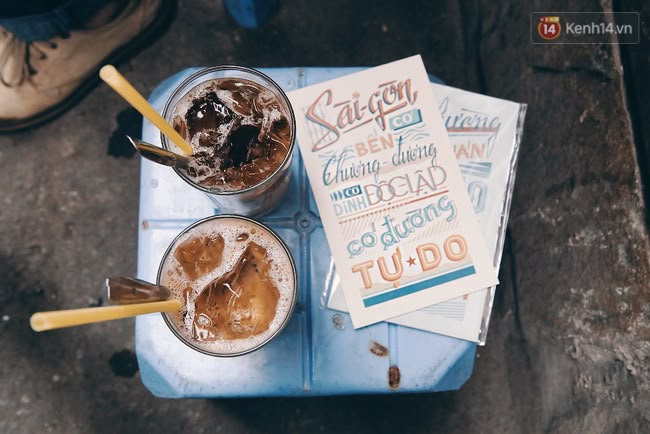
11/07/2025
In Vietnam, coffee is not merely a drink - it is a way of experiencing life. It is conversation, stillness, memory, rhythm, and a quite ritual that unfolds throughout the day. From the shaded sidewalks of Hanoi to the breezy riverside cafe in Saigon, coffee in Vietnam reflects the character of each region: refined, poetic, bold, and deeply personal. To travel through Vietnam is to follow the aroma of roasted beans, the whisper of coffee filters dripping slowly, and the soft clinking of glasses in morning life. Featured Tours