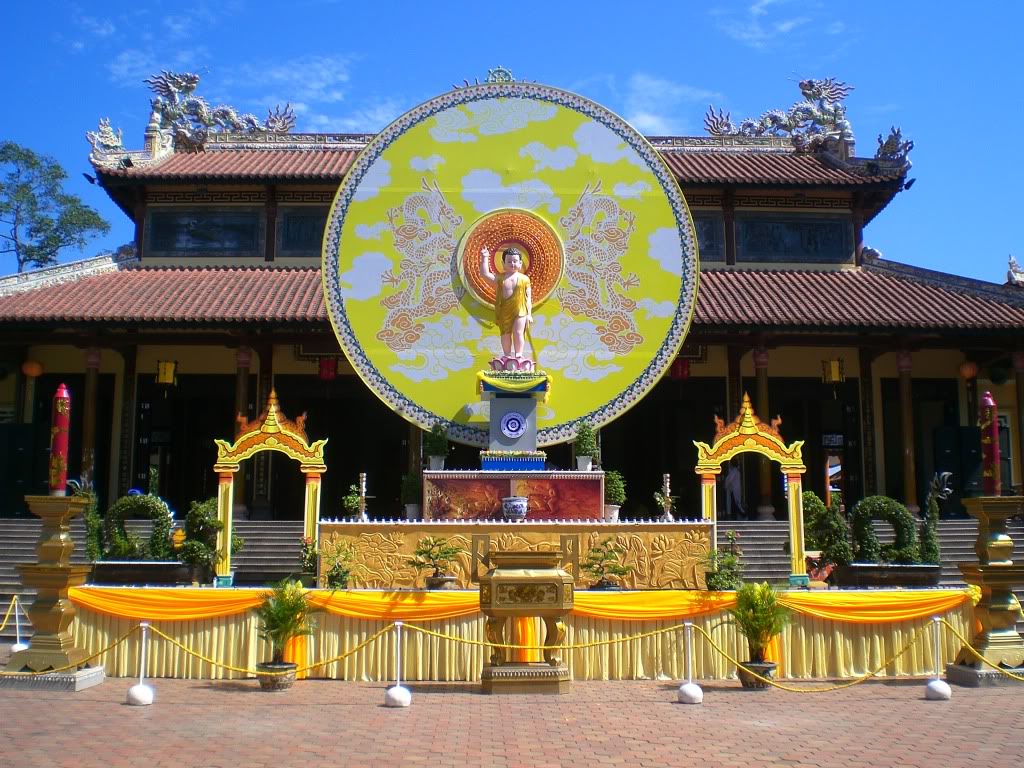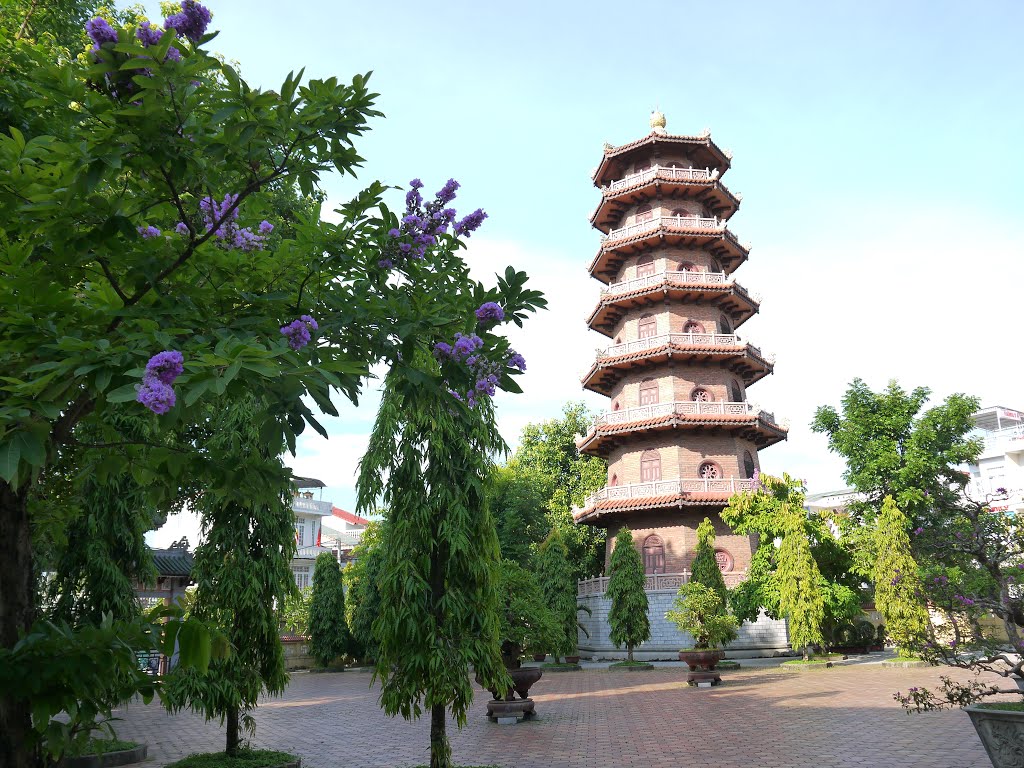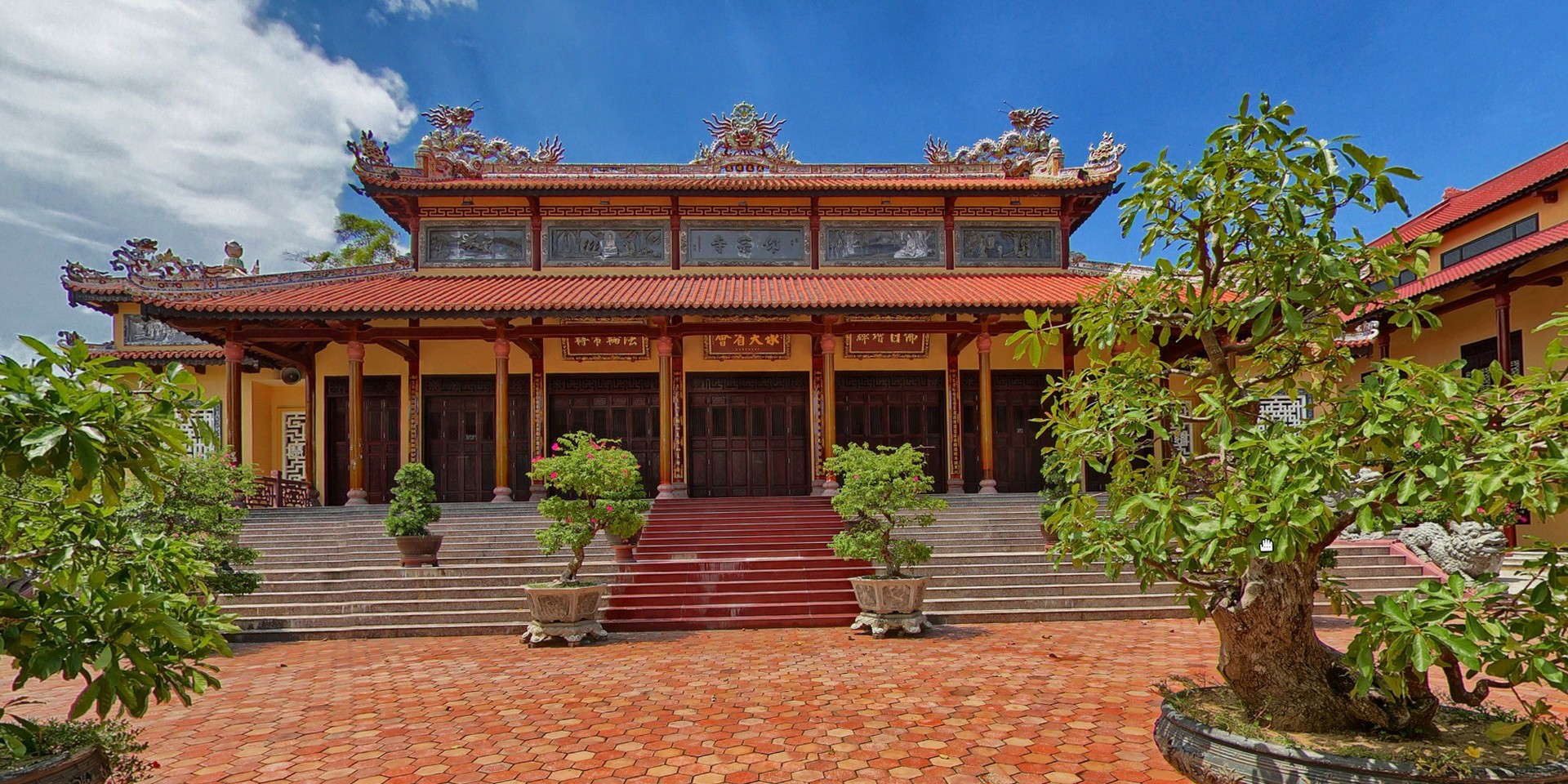
Location: Tu Dam Pagoda is located in the Truong An Ward, 2km from the centre of Hue City, along Dien Bien Phu Street, across Nam Giao Bridge up to the end of the first slope.
Characteristic: Tu Dam Pagoda was designed following the model of a Conference Pagoda (Chua Hoi). The old and new architectures blend together creating spacious and harmonious elements.
Tu Dam Pagoda is one of the biggest and oldest pagodas in Hue. The pagoda was founded at the end of the 17th century (in about 1695) by the Venerable Minh Hoang Tu Dung, a Chinese who belonged to the 34th sect of the Lam Te school of Zen. He was the high-ranking monk who taught and gave the certification to monk Lieu Quan, the Buddhist initiator of Vietnam in the south. Tu Dam Pagoda is famous and nationally known for its important role in the process of development of Buddhism, and the struggle for peace and for freedom of religion.
Tu Dam Pagoda is on a beautiful piece of land: high, wide and flat. It has a south-east orientation. Kim Phung Mount in the front served as a natural wind-screen. Linh Quang Pagoda and the temple dedicated to respectable patriot Phan Boi Chau stand on the left and Thien Minh Pagoda in the back. The three main parts of the pagoda are the three entrance-gate, the main sanctuary and the conference House. The gate is high and wide with a tiled roof. Just inside the gate is a big bodhi tree, providing shadow all year around. As a branch, this bodhi tree was taken right from the bodhi tree under which Buddha reached Nirvana. Mrs Karpeies, Head of the French Buddhist Association, brought it back from India as a present offered to the pagoda and planted it there in 1936. The pagoda yard was built on a very large surface so that it can provide enough space for thousands of people. Every year, on Buddha's birthday, it is a gathering place where many important and most crowded festivals of Hue’s Buddhists take place.
The main sanctuary consists of a service hall and an ancestors' altar. The service hall was built on a marble foundation 1.5m high with an old style roof forming a towering and impressive Pagoda. On the edge and top of the roof are many curving, gentle, symmetric pairs of dragons creating a well-balanced and harmonious beauty. Under the ancient roof are frescoes telling Buddha’s stories. Many long couplets are hung on the pillars of the Service hall. The building is flanked by two stele and drum towers.
Tu Dam Pagoda worships one Buddha only, so that its appointments are rather simpler than that of other pagodas in Hue. In the temple, there is a Buddha Sakyamuni sitting on a lotus pedestal. There are an ancestors’ altar house and a monks’ house behind the main temple. The two storeys Conference Hall is large and wide building with 10 rooms to meet the requirements of a Conference Pagoda.
 Latest News
01/05/2026
When travelers think of Vietnam, names like Hanoi, Halong Bay, Hoi An, or Ho Chi Minh City often come to mind. These iconic destinations are popular for good reason. However, beyond the well-trodden routes lies another Vietnam — quieter, more authentic, and deeply connected to nature and local culture. For travelers who have already visited Vietnam or those seeking meaningful, off-the-beaten-path experiences, the country offers many lesser-known destinations that remain largely untouched by mass tourism. Here are some of Vietnam’s hidden gems worth discovering.
12/04/2025
Vietnam Airlines announced that starting May 17, 2025, all its domestic flight operations will be relocated to the newly opened Terminal T3 at Tan Son Nhat International Airport.
11/07/2025
In Vietnam, coffee is not merely a drink - it is a way of experiencing life. It is conversation, stillness, memory, rhythm, and a quite ritual that unfolds throughout the day. From the shaded sidewalks of Hanoi to the breezy riverside cafe in Saigon, coffee in Vietnam reflects the character of each region: refined, poetic, bold, and deeply personal. To travel through Vietnam is to follow the aroma of roasted beans, the whisper of coffee filters dripping slowly, and the soft clinking of glasses in morning life. Featured Tours