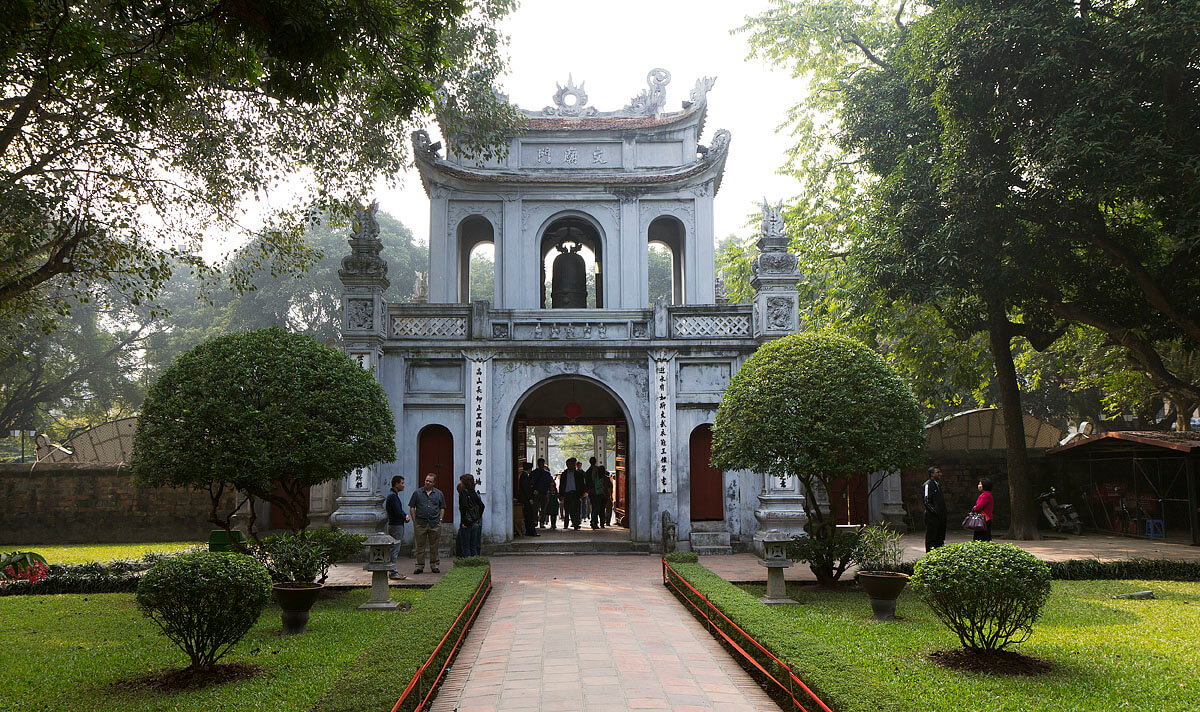
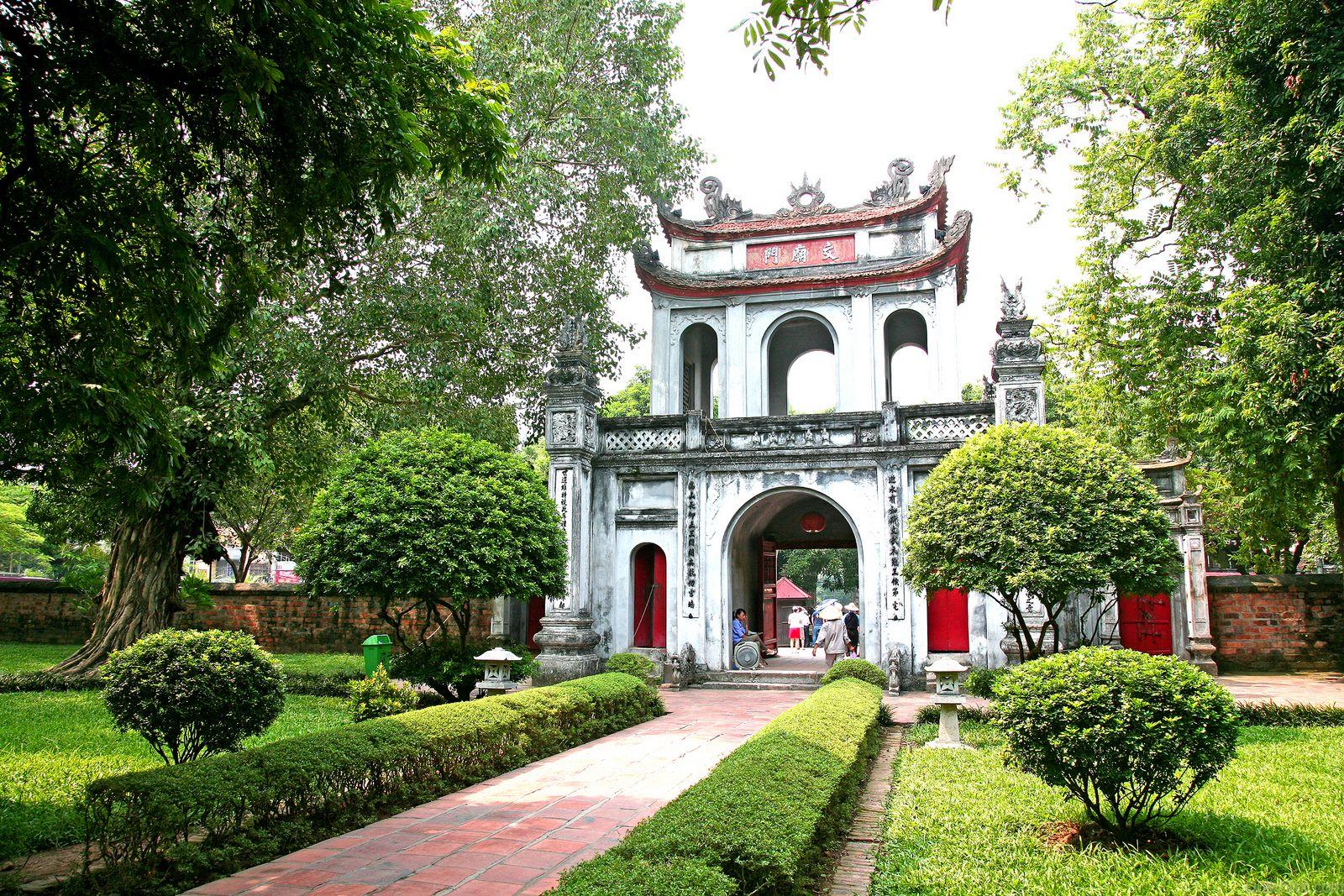
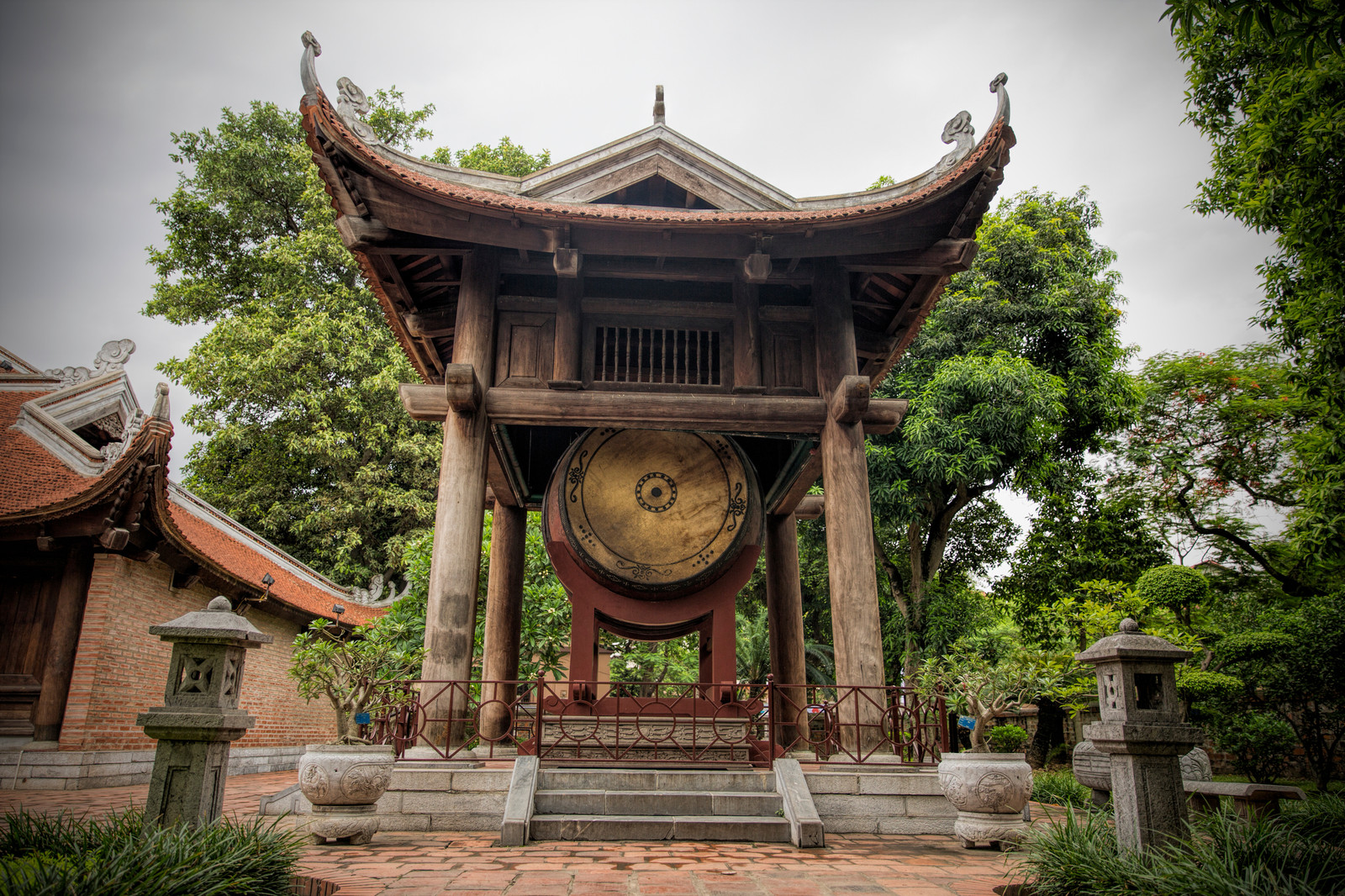
Van Mieu - Quoc Tu Giam is a famous historical and cultural relic consisting of the Temple of Literature and Vietnam's first university.
The Temple of Literature was built in 1070 in honour of Confucius, his followers, and Chu Van An, a moral figure in Vietnamese education.
Quoc Tu Giam, or Vietnam's first university, was built in 1076. Throughout its 900 years of activity, thousands of Vietnamese scholars graduated from this university.
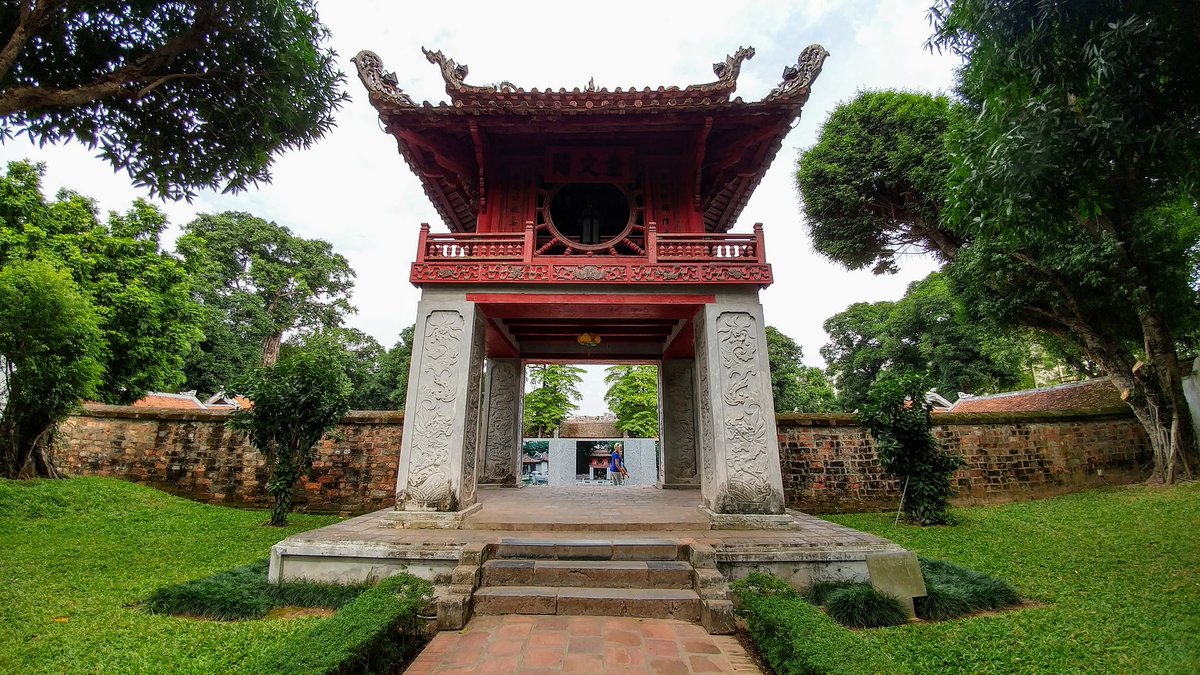
Khue Van Cac Pavillion of the constellation of literrature The artifacts collected during the recent excavation drives around Van Mieu (Temple of Literature) in Hanoi proved the architecture of this site belongs to the Ly (1010-1225) and Tran (1225-1400) Dynasties. Life of the students in olden times is reflected through these artifacts and seemed to be simple and pure compared to that of the city dwellers. Van Mieu - Quoc Tu Giam (National College) now preserves 82 steles engraved with the names of 1,306 doctors who obtained the doctoral titles at 82 royal examinations, held from 1442 to 1779. Although Van Mieu was built long ago, the architectural complexes in this area were erected much later. One of them was Khue Van Cac, or Pavilion of the Constellation of Literature, built under the Nguyen Dynasty (1802-1945). In 1802, Gia Long took the throne and built the capital in Hue. In 1805, the Commander of the Northern Citadel, Nguyen Van Thanh, ordered the construction of Khue Van Cac at Van Mieu. This project was carried out at the same time as the erection of the surrounding walls around Van Mieu in 1833. The pavilion was a two-storey complex made of wood and bricks, that is mirrored on the Thien Quang well. Located in the third courtyard (from the front gate), the pavilion's ground floor is empty, with four brick pillars of 85cm x 85cm engraved with designs of clouds. The pillars stand on a square base, 6.8 cm x 6.8 cm, which is covered with Bat Trang bricks. The upper floor, made of wooden frames, stands on four brick pillars, with four round windows facing the four directions and having rays like the sun. This floor is the symbol of the brilliant constellation that is shining. The Oriental people consider this star as a symbol of literature. On this floor, the balustrade is supported by engraved wooden pieces, and a gilt board with three letters of Khue Van Cac hangs on the wall.
 Latest News
01/05/2026
When travelers think of Vietnam, names like Hanoi, Halong Bay, Hoi An, or Ho Chi Minh City often come to mind. These iconic destinations are popular for good reason. However, beyond the well-trodden routes lies another Vietnam — quieter, more authentic, and deeply connected to nature and local culture. For travelers who have already visited Vietnam or those seeking meaningful, off-the-beaten-path experiences, the country offers many lesser-known destinations that remain largely untouched by mass tourism. Here are some of Vietnam’s hidden gems worth discovering.
12/04/2025
Vietnam Airlines announced that starting May 17, 2025, all its domestic flight operations will be relocated to the newly opened Terminal T3 at Tan Son Nhat International Airport.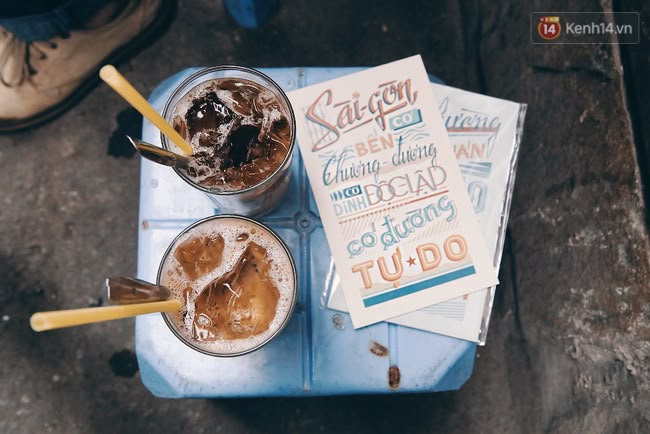
11/07/2025
In Vietnam, coffee is not merely a drink - it is a way of experiencing life. It is conversation, stillness, memory, rhythm, and a quite ritual that unfolds throughout the day. From the shaded sidewalks of Hanoi to the breezy riverside cafe in Saigon, coffee in Vietnam reflects the character of each region: refined, poetic, bold, and deeply personal. To travel through Vietnam is to follow the aroma of roasted beans, the whisper of coffee filters dripping slowly, and the soft clinking of glasses in morning life. Featured Tours